Genetic Algorithm (GA)
Overview
Genetic algorithm is a popular global optimisation method to find stable structures.
GA in gdpy makes use of functionalities in ase package and provides a user-friendly
interface by YAML.
The workflow of a GA-based global optimisation is

The steps are
Initial Population
Generate an initial population of structures.
Relax initial structures.
Iterate population until convergence.
Selection: Choose the best-N structures to form a new population.
Crossover: Use CutAndSplicePairing method to generate a new structure from two structures. This is critical to the success of GA. See the schema below. (Phys. Rev. Lett. 2012, 108, 126101.)
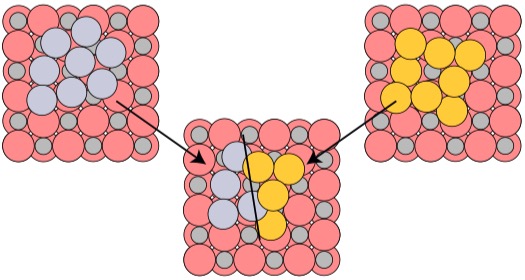
Mutation: Each new structure (offspring) has a possibility to mutate that part of structures are modified.
Minimisation: Relax new structures.
Convergence: If the maximum number of generations (iterations) reaches.
Anaylse structures.
Find structures with target properties in all explored structures.
Example
To use GA, the related commands are
# - explore configuration space defined by `config.yaml`
#   results will be written to the `results` folder
#   a log file will be written to `results/gdp.out` as well
$ gdp -d exp -p worker.yaml explore ./config.yaml

# - after GA is converged i.e. reaches the maximum generation,
#   all found minima will be saved to `./resuslts/results/all_candidates.xyz`
The GA input file ./config.yaml contains several sections:
method: This must be genetic_algorithm.
builder:
Define the builder that generates random structures. This is used to generate an initial population of structures. See RandomBuilders for more details. The example builder will put 4 Cu atoms on the substrate stored in the file ./sub.xyz. Cu atoms are randomly created in a lattice region, details of which can be found in Regions. More specific, Cu atoms will have arbitrary x- and y-coordiantes but z-coordinate within the range [7,7+6].
In the params section,
database: All explored structures are stored in this file with suffix .db.
property: Target property to minimise. (Only energy for now.)
convergence: Convergence criteria, e.g., the maximum number of generation.
population: Define how to organise a popultion.
init:
Number of structures (size) in the initial generation. These structures will be created by the method defined in the builder section.
gen:
Number of structures in the following generation. size is the total number. random is the number of structures generated by the initial builder while the rest is generated by the crossover operator.
pmut:
The probability for each reproduced structure to mutate.
operators:
comparator:
Explored structures are compared with each other. The probability of a structure to be selected as a parent is inverse of the number of its similiar structures.
crossover:
This is the most critical operator in GA.
mutation: List of mutation operators.
Each operator can be selected based on relative probabilities.
method: genetic_algorithm
builder:
  method: random_surface
  composition:
    Cu: 4
  region:
    method: lattice
    origin: [0., 0., 7.]
    cell: [11.174, 0., 0., 0., 8.413, 0., 0., 0., 6.]
  substrates: ./sub.xyz
  covalent_ratio: [0.8, 2.0]
  random_seed: 127
params:
  database: mydb.db
  population:
    init:
      size: 5
    gen:
      size: 5
      random: 2
    pmut: 0.8
  operators:
    comparator:
      dE: 0.015
      method: interatomic_distance
    crossover:
      method: cut_and_splice
    mutation:
    - method: rattle
      prob: 1.0
    - method: mirror
      prob: 1.0
  property:
    target: energy
  convergence:
    generation: 2
Application
Lee, M.-H.; Xu, J.; Xie, W. Exploring the Stability of Single-Atom Catalysts Using the Density Functional Theory-Based Global Optimization Method: H2 Formation on VOx/γ-Al2O3(100). J. Phys. Chem. C 2022, 126, 6973-6981.
Xu, J.; Xie, W.; Han, Y.; Hu, P. Atomistic Insights into the Oxidation of Flat and Stepped Platinum Surfaces Using Large-Scale Machine Learning Potential-Based Grand-Canonical Monte Carlo. ACS Catal. 2022, 12, 14812-14824.
Han, Y.; Xu, J.; Xie, W.; Wang, Z.; Hu, P. Comprehensive Study of Oxygen Vacancies on the Catalytic Performance of Zno for CO/H(2) Activation Using Machine Learning-Accelerated First-Principles Simulations. ACS Catal. 2023, 13, 5104-5113.